


Tell us about your background and how you got into writing.
I’m a born and raised New Yorker. I started acting as a child but fell into writing in my mid-twenties. It was the 1990s and there were very few plays for women my age, except for Wendy Wasserstein. Finding rich, new material was difficult. But it was an exciting time in New York for independent theater. You felt that if you wrote something, you could be in it and be part of the producing process. It turned out I was a much better writer and producer than I was an actor. Then I started writing articles and a novel, and never turned back.
You’ve spent decades observing New York and its people. How has the city changed, and has it affected your work?
I’ve had a long love affair with New York. She’s a beautiful beast. People have long written about the city and used it for inspiration. It has a strong presence in 90 percent of what I do and is often a character unto itself. Since Covid, NYC became heartbroken. It’s shifted to a place I don’t always recognize, and that’s been hard to watch. That affects you, as a writer and as a person who studies human behavior and culture. But also as a human.
Six years later, do you think the pandemic has permanently altered how we connect today?
During Covid, our devices, Zoom, and social media became a life force for us. But now, we’ve forgotten how to authentically and humanly connect. I just read an article about how scientists feel we’re speaking less to other people than we have in the past, and that we’re relying far too much on texting or DMing. I’m concerned that’s damaging us. We’re desperate for in-person connection as it is. This may be pushing us farther apart, rather than giving us additional tools for relating to one another.
Some of your live appearances take place in cemeteries and funeral homes. Explain!
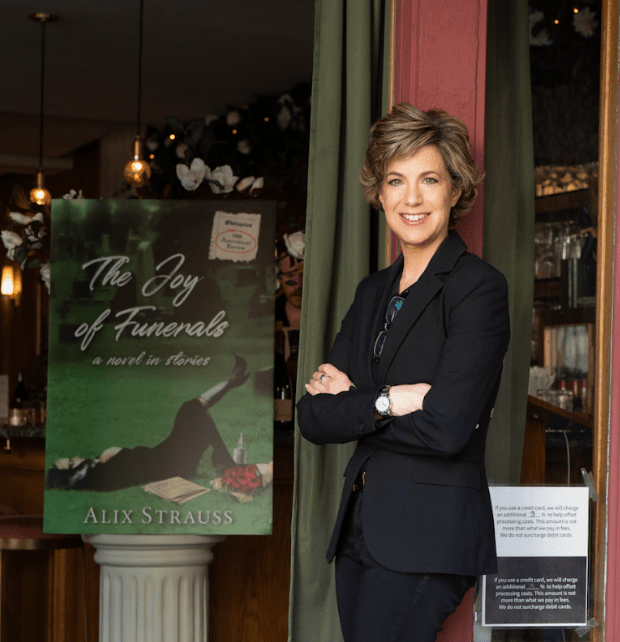
When my novel The Joy of Funerals originally came out, funerals and death were still taboo subjects. I knew that to get some attention for a novel with a title, material, and creative structure that was early to market, I would have to think outside the box. I went to the famous Frank E. Campbell funeral home and asked if they would host a book party. I expected them to call security. Instead, they said yes. That was a highlight for me, and a true New York moment. When it came time for the 20th-anniversary edition, I went back to Campbell and they were all in for round two. We requested guests come in funeral attire; we served cocktails called “The Afterlife” and “The Eulogy”; we served coffin and headstone cookies and a cake created to resemble the obituary section of The New York Times. A coffee-and-cream scented candle created by Literie called “Paying Respects” was in the gift bag. I added funeral homes and cemeteries to my book tour as well. Any kind of event you can create that thoughtfully brings people together, makes them feel connected and less alone is so important. Especially now when so many of us are feeling loss, loneliness, and grief. Those are themes that run throughout the novel as well, and so it made sense to bring everything together in a creative, unexpected, and unifying way.
What role does the Hamptons play in your life?
My relationship with the Hamptons started like most people in their twenties from New York—you have a summer share on alternative weekends with a bunch of people you don’t really know, who hopefully are not psychotic, and don’t become psychotic as the summer progresses, in a house you can’t afford on your own. You always hoped your bed was still there, that a drunk stranger wasn’t sleeping in it, and that the sheets were clean. All these years later, my goals remain the same, but my circumstances have thankfully changed. I have generous friends with lovely homes who invite me for the weekend, who are not psychotic, and have definitely changed the sheets, which are probably Frette. There are some wonderful hotels out there now, too, if things take a turn, and someone becomes psychotic.
How would you say the Hamptons differ from NYC?
It’s a completely different rhythm and vibe. The Hamptons is beautiful, lush, and green—a completely different feel, even from Central Park. It has an off switch; New York City doesn’t. Despite the numerous changes that have occurred since Covid, New York is still awake, even if she’s not thriving 24/7.
What are you working on right now?
My second novel, Based Upon Availability, which was a White Lotus before there was a White Lotus, is being reissued next year. I’m still covering trends and culture, and contributing to The New York Times. I’m also working on a fascinating true crime documentary, and just finished a new novel. As for The Joy of Funerals, we like to call it the book tour that never dies!