


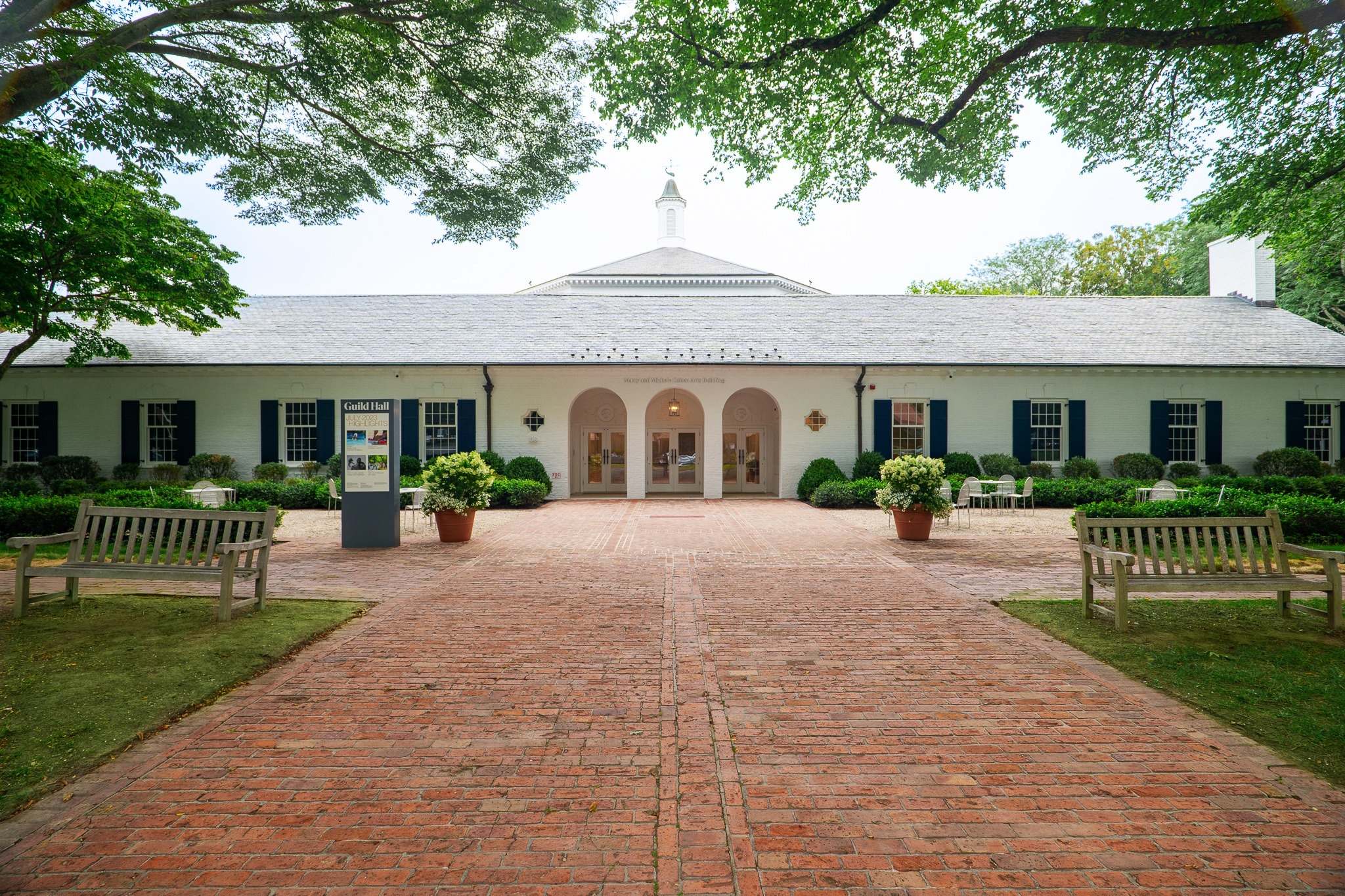
For almost 100 years, Guild Hall has served as East Hampton’s cultural mecca. Founded by Mary Woodhouse on the principle that participation in the arts creates greater civic engagement, the hall was one of the first multidisciplinary centers in the country. Since its opening in 1931, Guild Hall has become the cultural cornerstone of the Hamptons, combining a museum, theater, and education space under one roof. Because of its proximity to New York City, the artistry presented at the hall is uncommon for a small town.
In 1930, philanthropist Mary Woodhouse and her husband, Lorenzo E. Woodhouse, bought the land and started construction on the arts center. When it opened on August 19th a year later, it received great fanfare. “East Hampton has never known a celebration like that,” one resident at the time remembered. A thousand people showed up, packing into the theater and gallery.
Urban planner Robert Moses’s frequent collaborator architect Aymar Embury II designed the building in the Georgian style. Low-slung and featuring white painted brick, it faces East Hampton’s Main Street on the site of Samuel Miller’s former homestead, which predates the Revolutionary War.
Despite the hard times wrought by the Great Depression, much of the funding came from the community itself. John “Jack Black” Bouvier, First Lady Jacqueline Kennedy’s father, was among those who helped raised money. This was a community arts center meant for local residents, not the summer tourists, though they were also invited to attend and participate.
The theater was originally named after John Drew, uncle to Lionel, Ethel, and John Barrymore, and served as a summer testing ground for Broadway-bound productions. Playwrights Tennessee Williams and Eugene O’Neill would later credit Guild Hall with helping establish their reputations, and Who’s Afraid of Virginia Woolf? scribe Edward Albee was a lifelong friend to the cultural arts center and served as director for the summer season in 1972. Guild Hall also boosted the careers of painters Williem de Kooning, Roy Lichtenstein, and Jackson Pollock. As unknown artists, their work hung in the hall’s gallery, alongside art created by high school students, blurring the lines between world-class and community-based art. Guild Hall’s permanent collection houses 2,400 works of art.
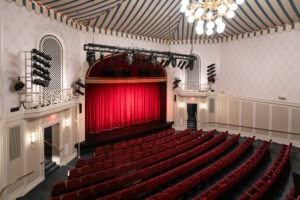
In 2022, Guild Hall began to undergo renovations. The John Drew Theater was renamed the Hilarie and Morgan Mitchell Theater, receiving new, broader, and more comfortable seating and greater space between rows. Following a $29 million capital improvement project, it also received a restored scalloped proscenium frame that had been part of Embury’s original design. The sound, lighting, and projection systems were also upgraded.
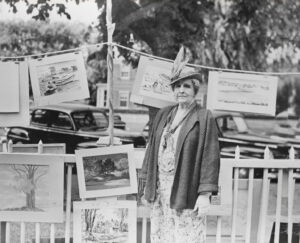
1930:
Mary Woodhouse and husband Lorenzo purchase the land, the former homestead of Samuel Miller.
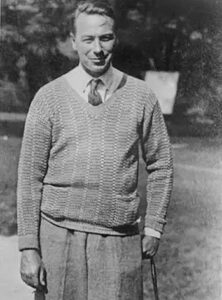
1931:
Designed by architect Aymar Embury II, Guild Hall opens on August 19, in the midst of the Great Depression. A thousand people show up to celebrate the occasion.
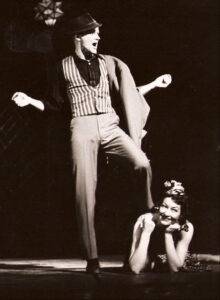
1951:
Theater legends Bob Fosse and Gwen Verdon star in Pal Joey. Both later became long-term residents, owning homes in East Hampton and Quogue.
1973:
The Guild Hall Museum receives formal accreditation from the American Alliance of Museums, one of the first institutions to be recognized.
2024:
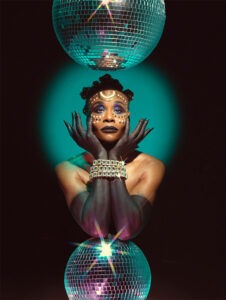
Singer/actor Billy Porter headlines the grand reopening benefit concert at the renovated theater.
Fun Facts:
- Mary Woodhousealso founded East Hampton’s first library in 1916.
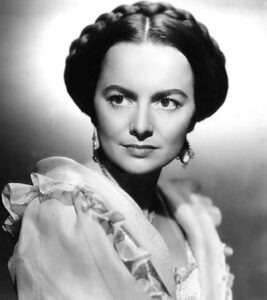
- Gone With the Windstar Olivia de Havilland performed twice at the John Drew Theater, in 1945’s What Every Woman Knows and 1951’s Candida.
- The Fantasticks becamethe world’s longest-running musical following a brief summer run at Guild Hall in 1960.
- In 1967, Guild Hallwas the site of the first bank robbery and narcotics raid in East Hampton. Burglars broke into an empty gallery, mistaking it for another gallery filled with priceless art for an upcoming exhibition.
Rob Asher