

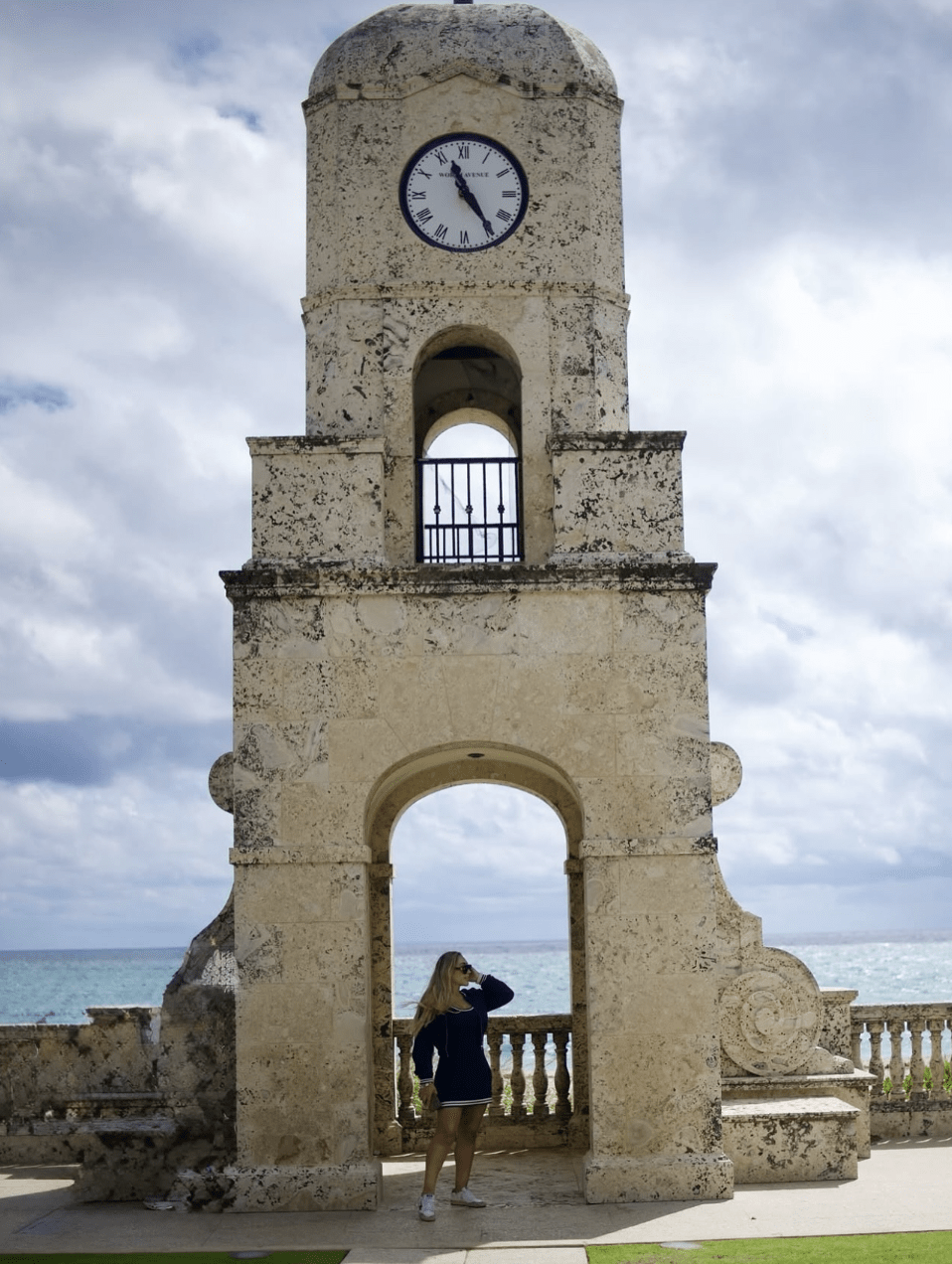
Crowning Worth Avenue’s easternmost point overlooking the Atlantic Ocean, the Worth Avenue Clock Tower roots trace back over a century, though the actual tower itself was built a mere decade and a half ago. Yes, really! The local landmark may look historic, but it’s 25 years young, built in 2010 to commemorate the Palm Beach Pier (which wasn’t even the pier’s original name, but more on that in a moment). In the early 1920s, enterprising Danish immigrant Peter Gustav Jordahn, aka Captain Gus, an avid swimmer who’d spent summers lifeguarding at Brooklyn’s Coney Island Beach, fell in love with Palm Beach and managed The Breakers’ pools before opening his own local pool complex, Gus’s Baths.
Located at Worth Avenue and South Ocean Boulevard, Gus’s Baths featured two heated saltwater pools, a diving platform, and a children’s wading pool, plus an apparel shop. It eventually grew to include a two-story building with 16 apartments, three gazebos, a boardwalk, and a tunnel connecting the pool to the public beach, attracting visitors as well as local regulars with daily, weekly, and monthly access options.
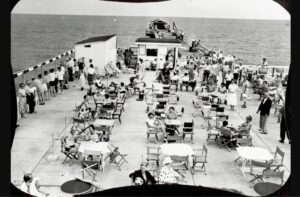
But pools were just the beginning of Captain Gus’s aquatic ambitions. In 1925, he opened Rainbo Pier, designed to compete with prolific developer and owner of the Breakers Henry Morrison Flagler’s namesake pier. Extending 1,000 feet into the ocean, Rainbo Pier offered fishing, its own pool complex, and sightseeing to visitors for the price of a dime. Captain Gus sold the pier a couple years later amid the Great Depression, and it was renamed Palm Beach Pier.
Meanwhile, in 1918, architect Addison Mizner began to dream up Worth Avenue, a chic Mediterranean-inspired shopping destination that opened five years later. Popular throughout the 1950s and ’60s in its Lilly Pulitzer–clad peak, it continued to be a see-and-be-seen hot spot in the decades that followed. By the 2000s, the retail hot spot began to show its age, and a $15.8 million renovation project brought about new trees to replace the yellowing original palms, fresh sidewalks—and a new clock tower to serve as a grand entrance to Worth Avenue, on the former location of Palm Beach pier.
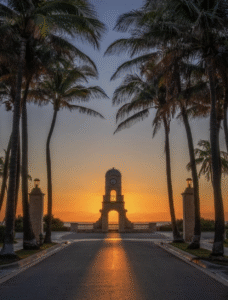
The Worth Avenue Clock Tower rises 25 feet in height and was constructed in the late aughts of stone and coral from the Dominican Republic in a Moorish Revival design style to complement the original architectural aesthetic of Worth Avenue. Costing $600,000 to build, it is one of the city’s newest landmarks, despite its venerable appearance.
TIMELINE
1923
Worth Avenue opens for business, offering a posh alfresco retail experience by the sea.
1924
Captain Gus begins construction on a pier of his own, dubbed Rainbo Pier, intended to outshine Henry Flager’s eponymous pier.
1925
Rainbo Pier opens on Labor Day, offering fishing, sightseeing, and pool complex.
1928
Captain Gus’s pier withstands a rough battering from hurricane Okeechobee, which completely destroyed rival Flagler’s pier.
1931
Captain Gus sells Rainbo Pier during the Great Depression, and it gets renamed Palm Beach Pier.
1950s and ’60s
Although the Palm Beach Piers flourished through the mid-20th century, multiple hurricanes in the 1960s pummel the pier.
1969
The city orders the storm-strained Palm Beach Pier to be demolished.
2000s
A major $17 million renovation of Worth Avenue kicks off, with the Worth Avenue Clock Tower as the project’s the crown jewel.
2010
The tower is complete and gets toasted with a dedication by the Town of Palm Beach and local business community.
DID YOU KNOW…
• Each year, early bird locals gather on New Year’s Day at sunrise for an annual selfie.
- An avid swimmer and former seaman with a record of saving more than 25 people in a single day during his Coney Island lifeguarding era, Captain Gus created a trained volunteer lifeguard unit in Palm Beach to patrol the town’s beaches in 1924, dubbed the “Cowboys of the Sea,” which is noted in a plaque inside the tower.
- Palm Beach Pier was a beloved gathering spot for locals for many kinds of pursuits, not just fishing, including a gin rummy group that played at a restaurant overlooking the pier.
- During the luxe shopping stretch’s midcentury heyday, it offered unrivaled retail therapy by day and, by night, après-gala waltzing in black tie in the moonlight. Palm Beach society would keep on dancing after soirées at the Everglades Club at the Palm Beach Pier in the 1950s and ’60s.