


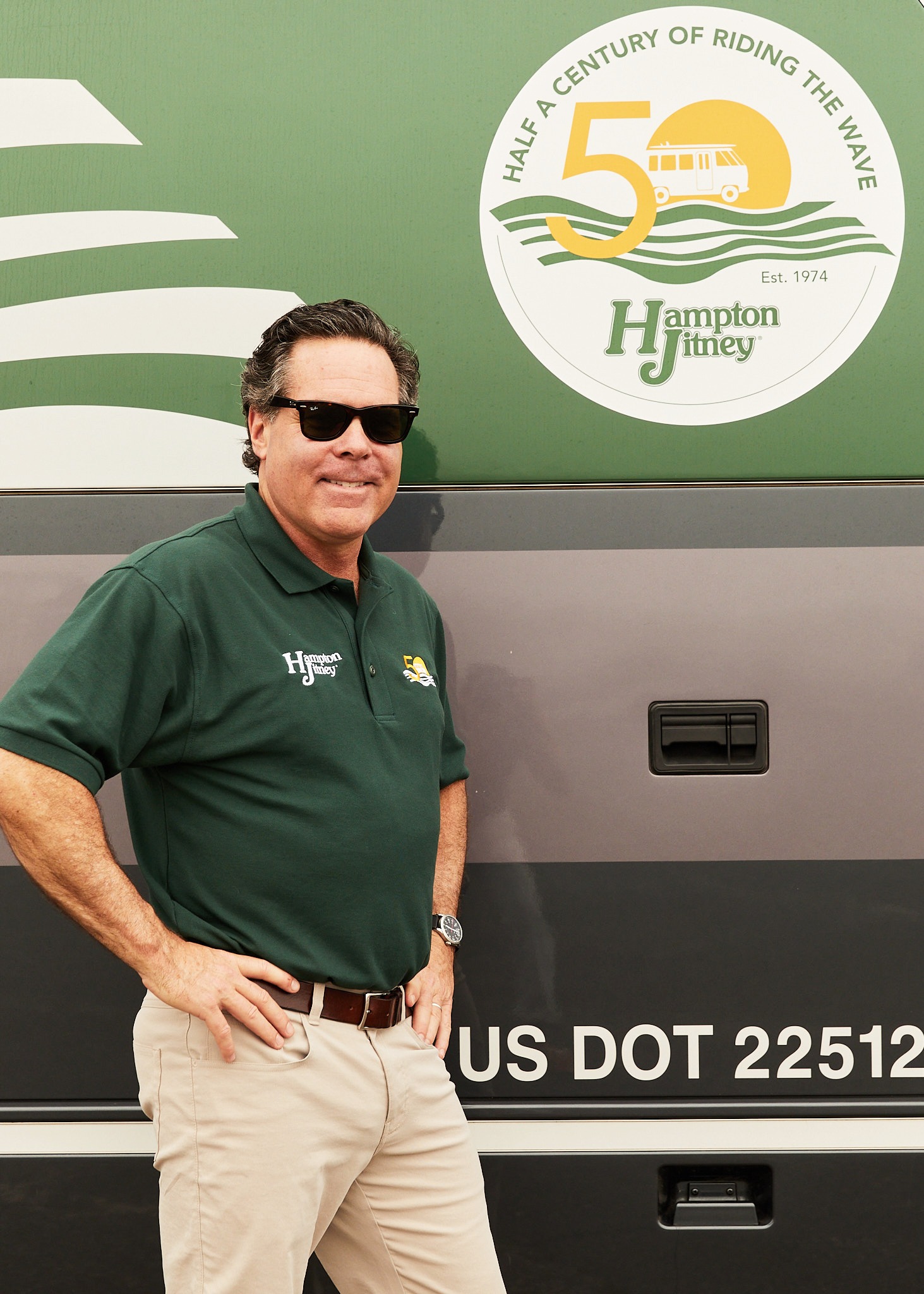
What was it like stepping into a business your family had spent decades building?
I didn’t really step in from the outside; I grew up in it. My parents bought Hampton Jitney in 1988 from Jim Davidson, who was the original founder. He had done an incredible job building the business but sadly became terminally ill. My parents had recently sold out of a business and met Jim through a family connection.
My siblings and I all worked for the company that first summer. I was 16 when I started as an onboard attendant. I went off to school and worked in Boston and NYC but came back full-time more than 20 years ago. When it’s your parents’ company, you’re mostly along for the ride. When it becomes your responsibility, you start shouldering the weight of over 200 employees and the challenges of running a hugely capital-intensive business. That combined with near 24/7 daily operation makes for quite a handful.
What does a typical day look like for you as executive vice president of Hampton Jitney?
There’s no single typical day, which is part of why I like it—one morning its fleet and scheduling, the next it’s a technology or a regulatory issue, and in summer it’s helping to make sure 65 buses and thousands of people are all where they’re supposed to be. When the phones are busy, I like to hop on and take reservation calls to get customer feedback directly. It’s the fastest way to find out what’s going on out there. Our customers love that when they call us, they always get a live human being; we need more of that these days.
Summer is obviously an incredibly busy time. What goes into preparing the company for the seasonal increase in travelers?
Summer planning happens all year round. We’re recruiting staff and securing additional equipment months ahead of Memorial Day. We spend hours on scheduling and trip planning. The complexity of our schedule is off the charts, and we’re constantly looking to add capacity where it makes sense. On the vehicle side, every coach goes through strict preventative maintenance every couple thousand miles and New York State has the toughest bus-inspection process of any state. On top of our own rigorous maintenance program, our partners at DOT thoroughly inspect every bus twice a year.
How does the business operate during the fall?
The volume changes, but the operation does not. We have an active charter business that picks up with the school calendar, so while our line run passenger counts may moderate, we continue to stay active. Employees appreciate that they can have steady work year-round with us. Fall is one of our favorite seasons out here—the North Fork wine and farm traffic, the ocean is still warm, people coming east because it’s beautiful and empty. The mix flips, too—more local and year-round riders, more people going into the city for the day rather than out of it. And it’s when we do the deep work on the fleet and start planning for the next summer.
What do you think has allowed the company to remain such an iconic aspect of the Hamptons for more than 50 years?
We’re not just a bus company that happens to serve the East End; our work started here and it’s our whole identity. Our people live in these communities. Our staff see the same riders over and over again. That changes how you treat someone. Beyond that, it’s consistency; we’ve kept running in bad years, kept the same logo, kept showing up 24/7/365. We’ve never assumed we’re doing well enough. Every ride is somebody deciding again that this is how they want to travel.
Why is the Jitney the best way to get to the Hamptons as opposed to other forms of transportation?
The convenience of our stops, one-seat trips, and not going underground. The trip Out East can sometimes be the worst part of the weekend, and we give you the freedom not to worry about it. You get on, you sit down, someone hands you a snack and water, your bags are handled, and two-and-a-half hours later you’re in the village—having read a book, taken a nap, or answered every e-mail you’d have otherwise done on Sunday night. Driving means you arrive already tired, and then you own a car you must park. We stop where people want to go—30 stops across the South and North forks—not at one station you then need a ride from. And you can do it every weekend without owning anything.
The Hamptons have changed tremendously. How have you seen your passengers and the community evolve?
The Hamptons continue to get increasingly more popular. A lot of the heavy bar and crazy share house scene has been chased out. Higher-end homes keep getting built, more restaurant options every year, and a focus on high-quality family time. Twenty years ago the East End emptied out after Labor Day. Now there’s a real year-round population out here—people who moved out permanently, people working hybrid, families whose kids are in local schools. That’s reshaped our business more than any change in who’s riding on a Friday in July. The other shift is that riders expect the same things they expect from every other service in their life—real-time information, easy booking, Wi-Fi that works. The bar for “good enough” moves every year, and it never moves down.
What has been the most rewarding part of watching Hampton Jitney grow?
One is doing something for work that provides real utility and is tangible. Another is the people. We have drivers, staff, and mechanics who’ve been here 20, 30 years—people my father hired who are still with us, and in some cases their kids now work here, too. Building something that supports families over that long is more meaningful than any route or revenue number. The other one is smaller: someone tells you they took the Jitney out while in college, then out with a baby, and now that kid takes it themselves. You’re in the background of people’s lives for decades. That’s rare for a company.
Window or aisle?
Window. Every time.
Jitney or Ambassador?
Whatever time fits my schedule. The Ambassador service is nice, but having a trip option at the right time is what makes the service great.
What’s the best time of day to make the drive Out East?
Thursday evening has gotten popular since COVID. Earlier in the day on Friday is better. The 7 or 8 a.m. out of the city on a Friday—you’re ahead of the traffic and you get a whole extra day out here. The other underrated one is late Sunday night going back west; it’s quiet, it’s fast, and you get one more dinner out of the weekend.
What’s next for Hampton Jitney in 2027?
We’re continuing to reinvest in new coaches; we purchase new vehicles every year (six in the past 12 months) and with prices upward of $700,000 per vehicle, that’s a lot of investment. On technology, we’re focused on the parts of the trip that happen before you board—booking, real-time tracking, an eventual app. Longer-term, we’re awaiting the first electric motorcoaches that have the range to fit our routes. We just passed 50 years in business, but the celebration was short because next season’s planning has already started.
Audrey Glass