


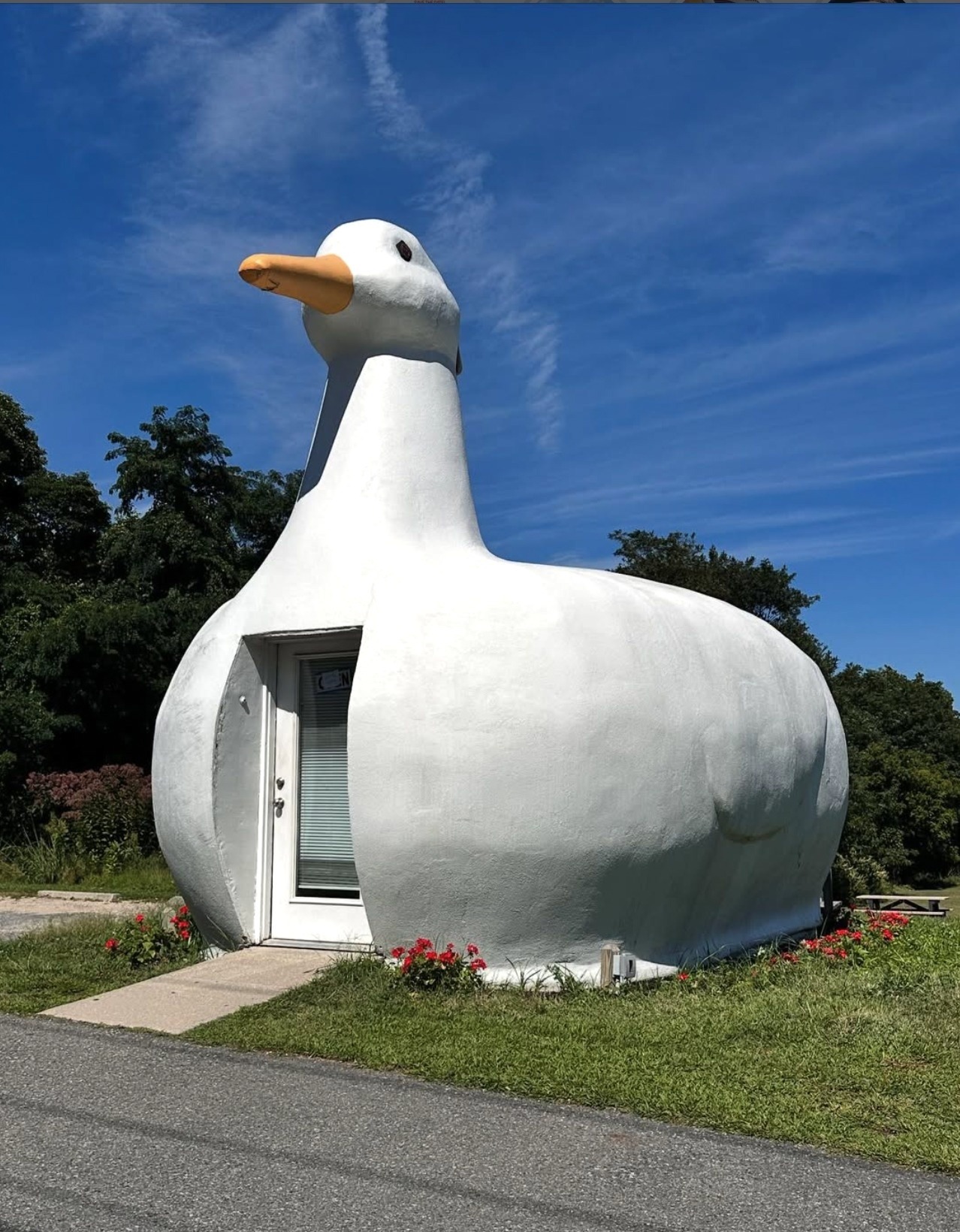
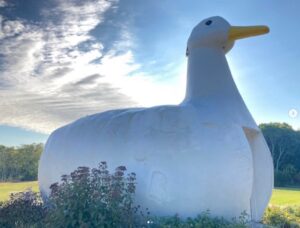
As you make your way Out East, it’s hard to miss one of Long Island’s most famous and eccentric landmarks—the Big Duck. Built in 1931 by duck farmer Martin Maurer, this whimsical piece of roadside art began its journey in Riverhead. After nesting in a few different locations over the years, it finally found a permanent home in 2007 in Flanders, in the northwest corner of Southampton. It cost a whopping $3,800 to construct it (equivalent to $62,900 in 2024).
The structure captures a unique moment in East End history. In the 1930s, duck farming was a growing industry on eastern Long Island; at the same time, novelty architecture was popular. The combination of both resulted in the creation of the Big Duck. Added to both the National Register of Historic Places and the New York State Register of Historic Places, it still serves as a quirky gateway to the Hamptons.
For weekend travelers, the Big Duck became a welcome sign that they were almost to their destination. But in the design world, it had a polarizing effect. In 1964, Peter Blake, managing editor of Architecture Forum, was one of the first architects to criticize the creature, citing it as a prime example of American roadside blight in his book God’s Own Junkyard. On the other hand, architects Robert Venturi and Denise Scott Brown celebrated the landmark and turned it into a textbook definition. In their 1972 book, Learning From Las Vegas, the vacationing couple coined the term “duck architecture,” which refers to buildings designed to look exactly like the products or services they sell.
Like Venturi and Scott Brown, most Long Islanders share the same passion for the Big Duck. Its Instagram page is a testament to its popularity, and is filled with fans sharing their art, memories, and affection for the iconic avian. But the ultimate display of local appreciation happens every winter when the Suffolk County Parks Department sponsors the Annual Holiday Lighting of the Big Duck. This community tradition since 1988 features hot cocoa, cookies, and doughnuts, plus local children singing carols.
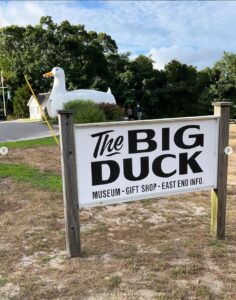
Today, the Big Duck is a visitor center and gift shop. Its merchandise includes apparel, mugs, postcards, rubber ducks, and more. The landmark’s grounds have also come alive with a new tradition in recent years: the Annual Big Duck Tag Sale. Launched by the Friends of the Big Duck (FotBD) and the Flanders Village Historical Society (FVHS), this community market is held in a grass field where vendors sell home décor, small furniture, antiques, and collectibles. All the proceeds benefit the FotBD and the FVHS.
The Big Duck is located at 1012 NY-24, Flanders, and is open year-round, seven days a week from 10 a.m.-5 p.m.
Did You Know…
- Built during the duck farming boom of the 1930s, the Big Duckoriginally sold ducks and ducks eggs.
- Firstowner Martin Maurer was inspired to create the Big Duck after seeing the Ben-Hur Delicious Drip Coffee on Wilshire Boulevard in Los Angeles in 1931.
- Theduck’s eyes are made from the taillights of a Ford Model T, and initially glowed red at night.
- TheBig Duckweighs a little over eight tons. In its entirety, it measures 30 feet from beak to tail, 15 feet from folded wing to folded wing, and 20 feet from its to the top of its head.
- A mini replica of the duck was made for the 1939 World’s Fairin NYC.
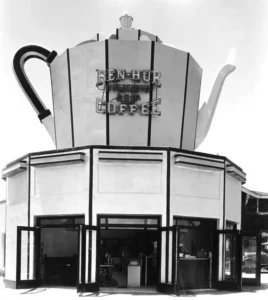
1931
The Big Duck opens in June in Riverhead.
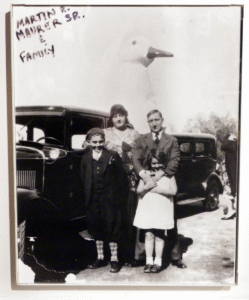
1937
Original owner Martin Maurer moves the Duck from Riverhead to Flanders, where he has a new duck ranch.
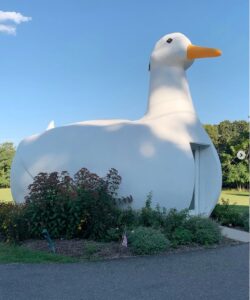
1984
The Big Duck closes as a poultry store. The Suffolk County Department of Parks and Rec acquires the structure and moves it to Sears Bellows County Park in Hampton Bays, where it’s repurposed as a gift shop in 1988.
2007
The Big Duck is returned to its original home of Flanders.
2021
The Annual Big Duck Tag Sale launches to benefit local organizations.
Rob Asher